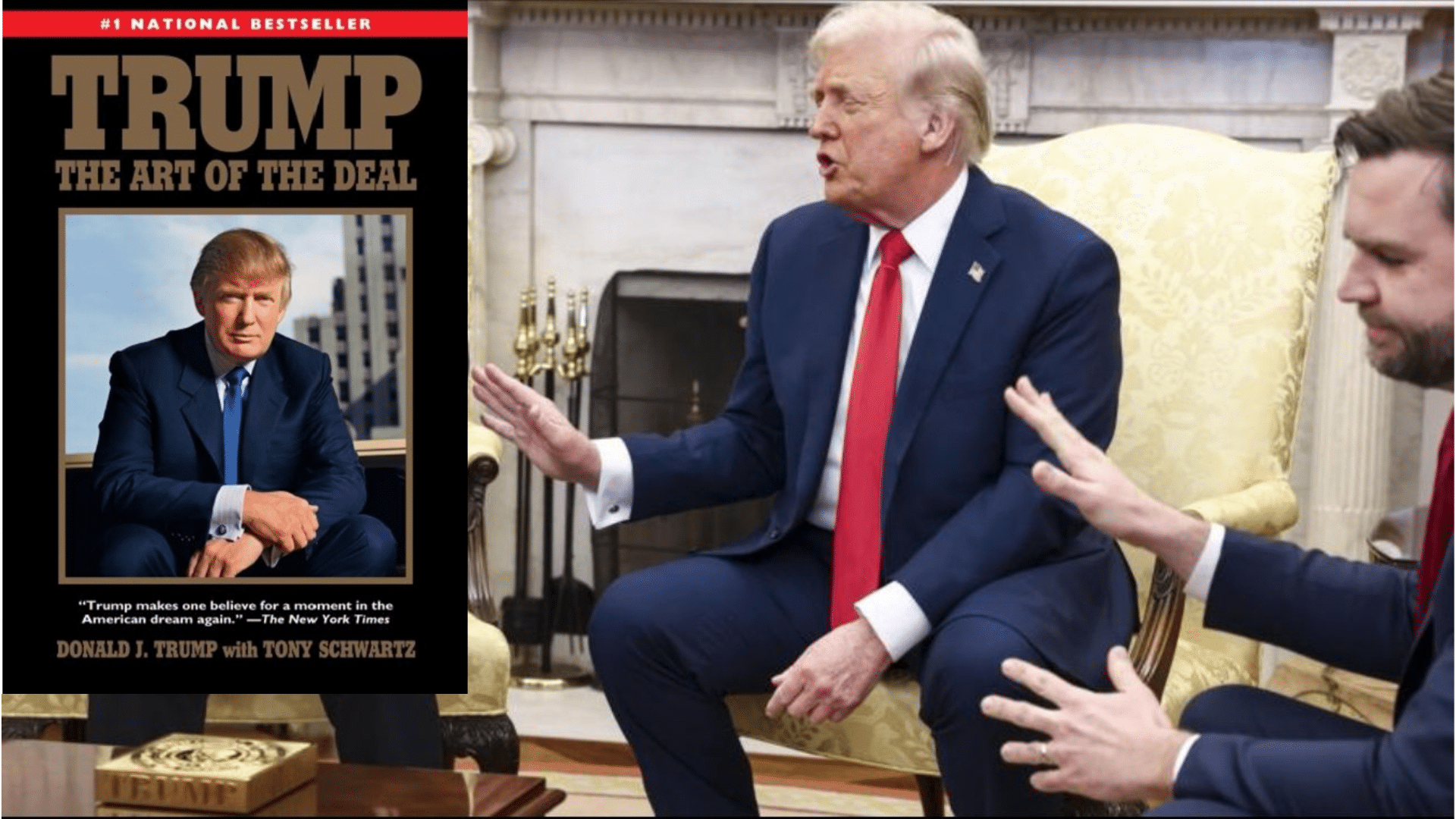
Art of the Deal: Outdated or Still Relevant After 40 Years?
Reconsidering Trump’s Bestseller: The Art Of The Deal After 40 Years
There is a certain kind of confidence that comes from having been right before. Not once, but repeatedly. It settles in quietly and becomes unshakeable. If you’re not careful, it can make you feel invincible. You stop checking yourself, your assumptions, quite so often. You begin to trust your instincts not just as useful, but as beyond doubt.
And that is where things start to drift, and you could end up in big trouble because the world does not stand still while we check our thoughts. It moves and changes shape. It mischievously introduces new variables, new constraints, and even newer actors. What once worked nicely can, over time, blunt itself.
Which brings us, somewhat inevitably, to The Art of the Deal. I remember reading it myself, being a fresh-faced salesman starting in the world of telecoms just after the “big bang” in the City of London. It was 1 of the few books I read more than once. I soaked it up like a sponge, and there’s no doubt it was a major factor in my sales thinking and successes over time.
But that was way back when AC15s and DASS2 were the connectivity orders of the day – long superceded by newer, faster, and arguably more reliable technologies. Can you see where this might be going?
Nearly forty years on from its publication, The Art of the Deal still casts a long shadow over how many leaders think about negotiation. The book’s principles are widely known, often quoted, and in some circles, still treated as a kind of sales bible. But the question worth asking, particularly for sales leaders navigating complex and challenging environments today, is whether The Art of the Deal remains relevant in 2026?
Or whether it is, in parts, horribly outdated.
The Art Of The Deal Author and The World It Was Written In
To understand whether The Art of the Deal still holds, we need to understand the world – the operating context – it was written for.
The 1980s business environment was, by comparison, simpler. Information was scattered and access to data was limited. Negotiations were often more contained, involving fewer stakeholders and much clearer lines of authority. Deals were frequently transactional, even the bigger ones. In that context, many of the principles outlined in The Art of the Deal made perfect sense.
Anchor hard. Create leverage. Control the narrative. Be willing to walk away. Move decisively.
These were not just tactics. They were life lessons to live by.
And to be fair, elements of The Art of the Deal still resonate. Clarity of intent is no bad thing, confidence in positioning is a definite plus, and a willingness to avoid weak compromises remains sensible in any negotiation.
But context matters. It really matters. It is almost trite to say that the world has changed since the 1980s. But it is worth pausing on what that actually means in the world of sales, deal-doing and negotiation strategy.
Globalisation has expanded the number of stakeholders involved in the most significant decisions. Digital transformation has democratised information, reducing the power imbalances that once gave negotiators an edge. Buyers are more informed, (much) more sceptical, and more interconnected than ever before.
Even within a single enterprise deal, you are no longer negotiating with “a company”. You are navigating a system of business processes and political influence. Procurement, finance, technical stakeholders, end-user customers, legal experts, and executive sponsors all bring different priorities, risks, and incentives.
In that environment, applying a single, forceful negotiating style can be problematic because you are no longer dealing with a unified counterparty. You are dealing with a network.
This is where blind reliance on The Art of the Deal can be very limiting. A playbook designed for contained negotiations (e.g. the New York Mayor’s office) struggles when applied to complex, multinational corporations with globally distributed decision-making processes.
And yet, many leaders continue to default to it to this very day. Put bluntly, they have failed to evolve in line with business and decision-making processes.
When Your Key Experience Becomes Your Key Constraint
There is a deeper issue here, and it’s not unique to The Art of the Deal. Experience and success can be lousy teachers. They reward patterns that worked in a particular context and fool us into repeating them. Over time, those patterns harden into strongly-held beliefs, and we forget to question whether the same rules or conditions still apply.
Take, for instance, classic persuasion frameworks like the ones popularised in the 1980s. Scarcity, authority, and social proof were powerful because information was scarce and verification was difficult.
Today, scarcity is often artificial (e.g. De Beers), authority can be questioned, and social proof can be manufactured and easily referenced. The principles themselves aren’t wrong, but the way we apply them is much more nuanced.
The same is true of the book itself. Its core ideas are not inherently flawed – far from it. But when applied with mapping to context, they are simplistic and can lose you more deals than they win.
Simplicity, in complex environments, is rarely your friend.
This modern-day tension becomes even more visible when we step outside the boardroom and wander up the road to Whitehall, Pennsylvania Avenue or even Freedom Square – the world of Geopolitics.
Recent commentary on LinkedIn, the Financial Times, and elsewhere regarding President Trump’s approach to Iran has repeatedly cited The Art of the Deal. The implication is that the same negotiating mindset can be – and is being – applied to international conflict.
But this is where the analogy begins to break down.
Geopolitics is rarely transactional. It is strategic in nature, shaped by culture and ideology, history, domestic politics, and long-term strategic positioning. The incentives are not aligned in the way they often are in business.
Iran’s leadership, for example, operates with a different time horizon and a different tolerance for pressure. It can afford to absorb economic pain and external pressure much longer than Western political systems can. In that context, tactics rooted in the world of dopamine hits – immediate and highly visible wins – are unlikely to deliver the intended outcomes.
Pressure does not necessarily lead to concession. It can lead to what negotiators often refer to as entrenchment. This is not just a geopolitical observation; it has direct relevance – and consequences – for sales leaders too.
Complex Deals Are Not Won Through Pressure Alone. Not these Days.
If you are selling complex products or services into large enterprises, you are not engaged in a simple negotiation. You are navigating a process that involves multiple stakeholders, competing agendas, and often, internal conflict within the same buying organisation.
In that environment, pressure can be counterproductive: Push too hard, and you create resistance. Force urgency where none exists, and you trigger frustration, confusion or outright rejection. Attempt to control the narrative too tightly, and you risk losing credibility.
This is where the limitations of a The Art of the Deal style approach become apparent. It assumes that the counterparty is ready, willing, and able to do a deal. In complex sales, that is rarely the case. It’s not a moment in time conversation; it’s a journey. Frustrating, maybe, but that’s the deal.
Often, your primary task is not to close a deal, but to help align all the parties. Until that happens, no amount of external pressure will move things forward.
You have to bring people with you.
One of the most underappreciated aspects of negotiation is that different stakeholders are, in effect, speaking different languages.
A CFO thinks mainly in terms of risk and return. A technical lead is thinking about feasibility and integration. A procurement team is focused on price and compliance. A CEO may be thinking about strategic positioning.
Approach them all with the same message, the same tactics, the same pressure, and you will struggle – which is a softer way of saying you’ll lose.
This is where adaptability becomes critical. You are not just negotiating a deal. You are negotiating meaning or the “so what” question. You are translating your proposition into terms that resonate with each stakeholder, with their own particular needs, and that requires a level of nuance that goes beyond the more forceful, one-dimensional tactics often associated with The Art of the Deal.
The Risk Of Misreading The Game
There is a phrase often used in competitive environments: are you playing the same game as your opponent? In many failed negotiations, the answer is no.
One party believes they are in a transactional negotiation. The other sees it as a strategic decision. One is focused on short-term outcomes – the here and now. The other is optimising for long-term positioning, and this kind of misalignment creates friction in the system.
And it is precisely where our successful past experiences can mislead us.
If you have built your career in environments where certain tactics worked, you may assume they will continue to work elsewhere. But if the underlying game has changed, those tactics may no longer be effective.
This is the risk of applying The Art of the Deal literally and without considering the wider context in 2026.
You may be negotiating with confidence, but in the wrong context, that’s a losing approach.
What Still Works From The Art Of The Deal?
It would be easy, at this point, to dismiss The Art of the Deal entirely, but that would be a mistake. Some elements remain highly relevant and valuable.
Did Trump actually write Art of the Deal? Listen: Tony Schwartz on Art of the Deal.
Clarity is important.
Knowing what you want from a negotiation remains essential.
Weak positioning still results in poor outcomes.
Willingness to walk away from a bad deal remains a strong leverage.
These are not outdated ideas. But they are not sufficient on their own. In modern, complex negotiations, they need to be complemented by a deeper understanding of operating context, stakeholder dynamics, and long-term relationship-building.
In other words, your strength needs to be balanced with insight.
If there is a single shift that defines effective deal-making in 2026, it is this:
The move these days has shifted from controlling to something more nuanced. In the 1980s, control was often the objective. Control the information. Control the narrative. Control the pace of the negotiation. Today, control is elusive and often counter-productive.
Today, information is widely available. Narratives hotly contested. Timelines and other variables are all influenced by multiple stakeholders and external events beyond your direct control.
What you can control, however, is your understanding of these variables. Your ability to map the stakeholder landscape. To identify the real decision-makers. To understand the pressures each party is under. To align your proposition with their priorities. This is where modern negotiation is won.
A Final Reflection For Sales Leaders
Succeed not through dominance. Succeed through understanding.
You might not be negotiating with sovereign governments, but you are still negotiating with:
Hiring managers about your next role. Clients on significant contracts. Internal stakeholders about strategy and investment. Even, at times, with your partner about what’s for dinner tonight (!). In each of these situations, the same principle applies:
If you want an acceptable outcome, you need to take into account the other party’s needs.
You can force agreement but you cannot force an enduring agreement.
Without deal commitment, deal integrity is at risk.
So, as you reflect on The Art of the Deal, the real question is not whether it is right or wrong. It is whether you are applying its principles with sufficient awareness of the context you are operating in. The world has changed manifestly since the 1980s.
The leaders who succeed in complex environments today are not those who rely most heavily on what worked in the past. They are the ones who understand, deeply and consistently, what is happening in the present.
Leaders adapt accordingly.
More Trump commentary here
More sales blogs here