
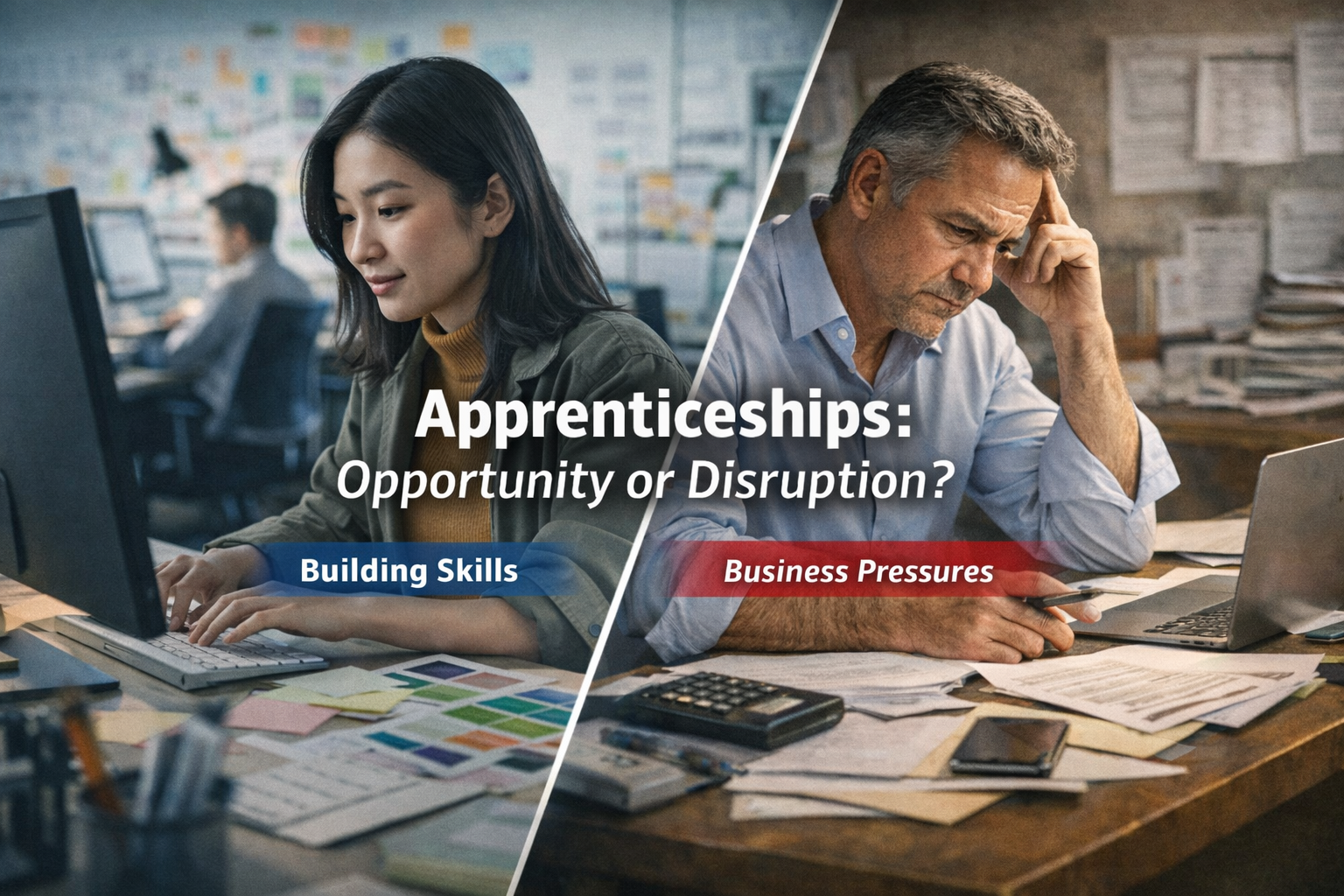
Why SMEs Don’t Invest in Apprenticeships (Even When the Economics Make Sense)
Why SMEs Don’t Invest in Apprenticeships remains a surprisingly difficult question to answer, even when the economics appear so compelling.
Apprenticeships are heavily funded and widely promoted, yet many SMEs still hesitate. The real reason has less to do with cost and more to do with how decisions are made inside small businesses.
There is a quiet frustration building inside universities across the UK.
On paper, the case for apprenticeships is compelling. The demand curve is strong, the need for skills has never been greater, and the economic logic appears so sound. And yet, when it comes to small and medium-sized businesses actually committing to invest, the numbers stubbornly refuse to follow.
I was reminded of this in a recent conversation with a university team preparing to launch a new creative apprenticeship. The ambition was clear, the programme thoughtfully designed, and the industry demand very real.
What struck me, however, was something more subtle.
This was not one clear decision being presented to SMEs, but several overlapping ones.
For some, it was about hiring a new team member and choosing to do so through an apprenticeship. For others, it was about investing in an existing employee, accepting a short-term dip in output in exchange for longer-term capability. In many cases, that employee is already being paid at the appropriate market rate for their current role. The apprenticeship is not about reducing salary cost, but about accelerating capability.
An operations manager, for example, might remain at their existing salary while completing a project management degree apprenticeship, gradually taking on more complex responsibilities as their skills develop. Over time, the role evolves, not just the qualification.
Seen this way, the apprenticeship is less about hiring cheaply and more about structured progression. Different starting points, different internal conversations, and no single, consistent message about what was actually being asked.
And that matters.
Because when a decision feels unclear, it rarely gets made at all. In smaller businesses especially, where time is tight and priorities compete daily, anything that feels even slightly ambiguous is quietly deprioritised.
Which brings us back to the central question.
Why is it so hard to persuade SMEs to say yes?
Because this is not simply a marketing problem, nor is it just a question of funding. It is, at its heart, a decision-making problem. And until we understand how that decision is really made inside a small business, no amount of promotion, events, or carefully crafted prospectuses will move the dial in any meaningful way.
The Illusion of a “No-Brainer”
From a distance, apprenticeships feel like something that should be easy to say yes to. The economics are strong, the structure is in place, and the intent is difficult to argue with. Build capability, develop talent, strengthen the future workforce. On paper, it reads well.
But the decision’s not made on paper.
Inside an SME, the conversation unfolds very differently. The funding is acknowledged, often quickly, and then set to one side. Not dismissed, but deprioritised. Because once the headline numbers are understood, attention shifts to something else entirely.
Exposure.
Not financial exposure, but operational exposure. What happens when a key member of the team is out of the business for structured learning? What happens to deadlines, to delivery, to clients who are expecting continuity? What happens if the individual struggles, or if the timing proves more difficult than expected?
These are not edge cases. They are the centre of the decision.
And they are felt more acutely in a small business than in almost any other environment. There are fewer buffers, fewer layers, fewer places for disruption to be absorbed. What might be manageable in a larger organisation becomes immediately visible in a smaller one.
This is why the “no-brainer” framing rarely lands in the way it is intended.
It assumes the decision is primarily economic. In reality, it is experiential. It is shaped by how the business expects the next few months to feel, not just how the numbers sum over time.
Which is why even a highly funded, well-designed apprenticeship can still hesitate at the point of commitment.
Not because the value is unclear, but because the impact is.
What SMEs Are Really Worried About
Once you move beyond the funding, a more uncomfortable set of concerns begins to surface.
Time and disruption sit at the top of the list. An apprentice is not plug-and-play. They require supervision, structure, and patience, and in a small business, that support has to come from someone who is already busy. It is not just a cost question; it is a productivity question.
Then there is hiring risk. A poor hire in a micro business is not inconvenient; it is genuinely disruptive. Apprenticeships can amplify that perception because they imply a longer-term commitment, even if the intention is to build capability over time.
And finally, there is the issue of delayed return. With around 20% of time spent in learning, the benefits are not immediate. For many SMEs, that creates a tension between short-term delivery and longer-term development, and in most cases, the short term wins.
This is the reality most apprenticeship messaging never quite addresses.
Why SMEs Don’t Invest in Apprenticeships
One of the most persistent assumptions is that better awareness of funding will unlock demand.
It won’t.
Not because the funding isn’t generous, but because it targets the wrong part of the decision process.
Most SMEs, once they understand that government funding can significantly reduce the cost of training, don’t suddenly lean forward. If anything, they pause. Because the question they are really trying to answer has very little to do with contribution levels.
It is this:
What does this actually look like inside my business next week?
That question rarely appears in brochures, but it sits at the centre of the decision. Not as a financial calculation, but as a practical one. Who picks up the work when the apprentice is off-site? Who provides the structure, the feedback, the oversight? What happens if the timing is wrong, or the hire doesn’t land as expected?
These are not abstract concerns. They are immediate, operational, and often personal to the decision-maker.
Which is why the comparison universities often make, between the cost of an apprentice and the cost of hiring at market rate, quietly misses the point. For an SME, the trade-off is not between two salary lines. It is between maintaining momentum and deliberately interrupting it.
And in a small business, momentum is everything.
This is where many well-intentioned conversations begin to lose traction. The proposition is framed as an opportunity, but experienced as a disruption. The numbers may work, the logic may be sound, but the pathway from decision to delivery feels less than clear.
So the decision stalls.
Not because the SME cannot see the value, but because they cannot yet see how it works in practice without creating strain elsewhere in the business.
And until that gap is closed, no amount of funding clarity will change the outcome.
You could be forgiven for thinking this is simply a perception problem. That if SMEs better understood the funding, the structure, and the long-term value, demand would naturally follow.
The evidence suggests otherwise.
In the years following the introduction of the Apprenticeship Levy, SME participation fell sharply. Apprentice starts in smaller businesses declined by almost half over a four-year period, not because the need disappeared, but because the system became harder to navigate and, in many cases, harder to justify in practice.
Even now, the market remains narrow. Thousands of vacancies exist, but they are concentrated across a relatively small number of employers. For many SMEs, this is not yet a normal hiring route. It is something others seem to be doing.
At the same time, cost pressures have not stood still. Wage expectations have risen quickly, and while government funding supports the training, it does not remove the day-to-day cost of employment or the operational impact of time away from the business.
Taken together, this creates a more uncomfortable truth.
This is not a case of strong demand waiting to be unlocked.
It is a supply constraint.
The limiting factor is not student interest, but employer confidence.
And that shifts the conversation in a way that most apprenticeship messaging has yet to fully absorb.
What Actually Changes the Decision
When SMEs do say yes, it is rarely because of a brochure or a campaign.
It is because something shifts in how the decision feels in practice.
Often, it starts with a clear and immediate use case. The role is not abstract, but tied to real work that needs to be done. The apprenticeship is not an idea, but a solution to a defined problem.
Trust also plays a part. SMEs are far more likely to move forward when the opportunity is introduced or validated by someone they respect, rather than presented as a generic proposition.
But most importantly, the business has reached a point where it believes it can manage the trade-offs involved.
Because the real question is not whether there is value in an apprenticeship. Most SMEs can see that.
The question is whether they can absorb the short-term reduction in productivity that comes with it, and whether the business can continue to function effectively during that period.
That might mean redistributing workload across the team, delaying less critical work, or being very deliberate about how the apprentice contributes from day one. In some cases, it may also mean external support to help structure the role properly.
In other words, the decision is not driven by information.
It is driven by confidence that the business can withstand the short term in order to benefit from the long term.
The Bigger Misread
This is where most universities unintentionally get it wrong.
They believe they are selling an apprenticeship.
In reality, they are asking an SME to make a talent investment decision they were not planning to make.
Sometimes that means hiring a new employee earlier than expected. Sometimes it means committing to upskilling an existing team member and absorbing a short-term reduction in productivity. Either way, it requires a shift in priorities, time, and attention.
And yet, the message is rarely presented that clearly.
Instead, SMEs are often given multiple entry points, multiple interpretations, and multiple versions of what the apprenticeship represents. Is it a hiring route? A training programme? A development pathway? A funding opportunity?
All of those things may be true.
But taken together, they create ambiguity.
And when the message is not clear, the decision becomes harder to make. In smaller businesses, where time is limited and focus is everything, that ambiguity is often enough to stop the process before it properly begins.
This is not a failure of intent.
It is a mismatch between how institutions communicate and how businesses decide.
And it explains why, even with strong programmes and generous funding, the message does not always land in the way it should.
A Different Way to Think About It
If we step back, a more effective way to approach this begins to emerge.
Not as a single attempt to “sell” an apprenticeship, but as a process of building enough confidence for an SME to say yes at the right moment.
For some businesses, that moment comes when they already have a hiring need and can clearly see how an apprentice fits into the role. For others, it may come later, once they have had some form of prior engagement, whether through internships, short-term projects, or simply a better understanding of how apprenticeships work in practice.
There is no single path into the decision.
But there is a common thread.
SMEs are far more likely to commit when they feel they understand what they are taking on, trust the source of the opportunity, and can see how it fits into the reality of their business.
For a university looking to fill a new cohort, that has an immediate implication. The focus should not just be on reaching more businesses, but on identifying those where the conditions are already aligned, where there is a real need, a degree of readiness, and a clear fit.
Do that well, and numbers follow.
But there is also a longer-term opportunity here.
Each SME that engages, whether through an internship, an apprenticeship, or another form of collaboration, becomes part of a wider relationship. Over time, those relationships build familiarity, reduce perceived risk, and make future decisions easier.
In that sense, this is not just about filling a cohort.
It is about creating the foundations for a more consistent, more predictable flow of engagement over time.
Closing Thought
Apprenticeships remain one of the most powerful professional development tools we have to bridge the gap between educational attainment and employment, and maybe, even drive social mobility.
And that is what is at stake here. The apprenticeship brand is strong, but distribution and uptake are weak. This is much more than filling courses or meeting targets. It is about creating opportunities that can genuinely change the trajectory of someone’s working life, while at the same time helping businesses grow and adapt.
But for that to happen, both sides of the equation need to be properly understood.
And that is not just a theoretical point. It is a deeply personal one. My own career started as a telecoms apprentice back in the 1980s, and the 3-year programme shaped everything that followed. It was not just a training programme. It was the foundation of (I hope) a successful sales career.
Which brings us back to where the real work lies.
Not in shouting apprenticeships from the rooftops per se, but in making them easier to say yes to.