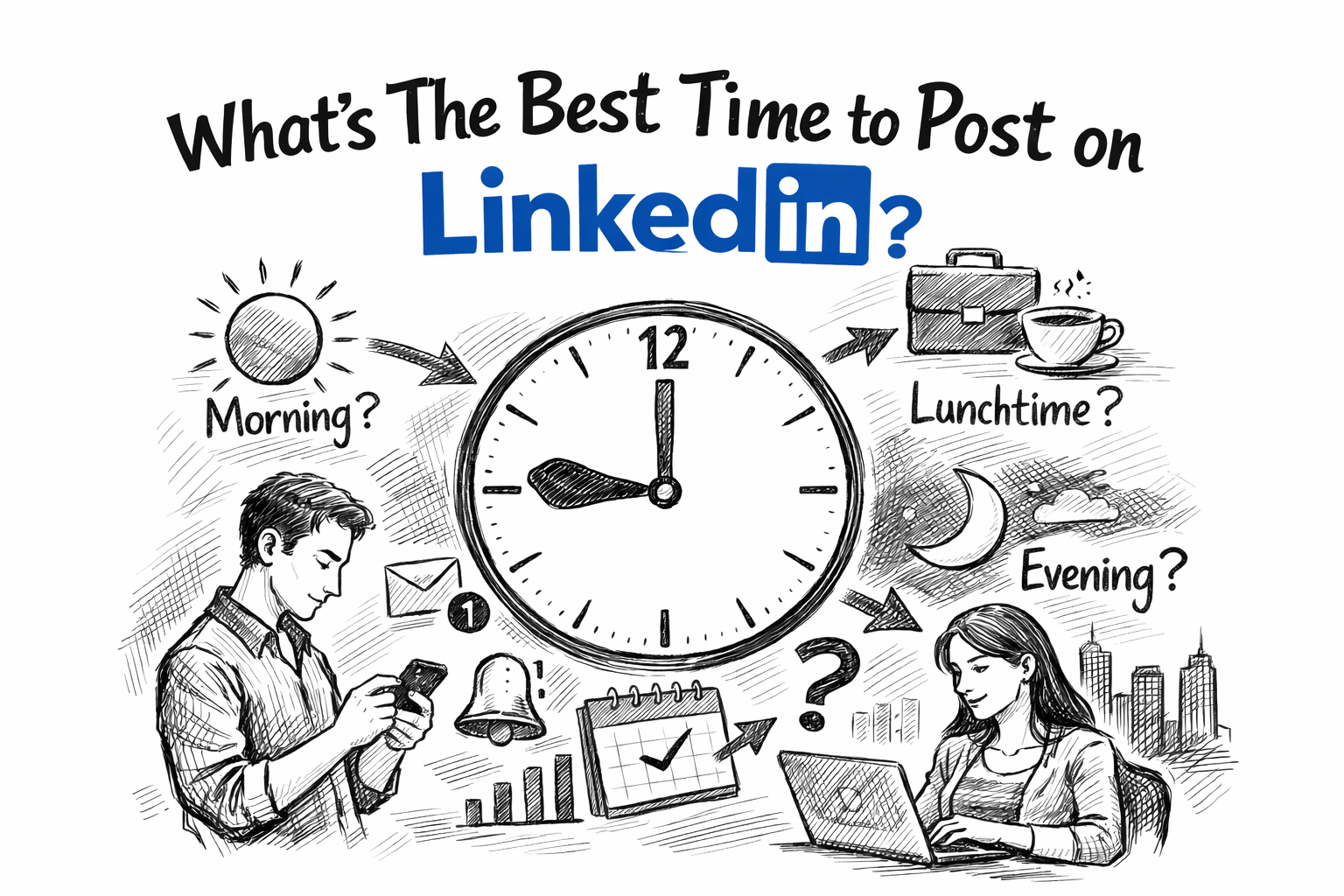
2026: What’s The Best Time to Post on LinkedIn?
Remember When The Best Time to Post Was on Your Daily Commute?
There was a time when LinkedIn’s advice about the best time to post felt disarmingly comforting in its certainty. “Post at 8:30am” they said. “Catch people on their daily commute”, they said. Be there as they scroll through their phones on packed trains, wedged between total strangers, avoiding eye contact and killing time. It’s what smartphones were made for!
That advice made sense because way back when, this was everyone’s typical day. Anyone who spent time on the 07:42 into London Waterloo, the shuffle into Grand Central Terminal, or the early platforms at Frankfurt Hauptbahnhof knew exactly what LinkedIn was competing with: not meetings or inboxes, but boredom. The commute created a strangely reliable window of attention. You could almost set your watch by it. Then the world shifted with Covid-19.
Table of Contents
Remote work blurred our working hours. Hybrid schedules and the school run disrupted the morning rhythm. Commutes shortened, disappeared, or fractured into something less uniform. People started their days earlier, later, or in fragments. Some scrolled before the household woke up. Others checked LinkedIn between school runs, stand-ups, or while waiting for the kettle to boil (checks mirror).
The daily commute is no longer a sure thing. It no longer guarantees that attention window. And yet much of the advice on LinkedIn still thinks these are the best times.
This is where many people go wrong. They inherit rules from a different era and apply them to a platform that now runs on very different dynamics. The result is content that feels well-judged but lands poorly; thoughtful posts that disappear without explanation, and a creeping sense that LinkedIn is somehow harder than it used to be. It is harder. But not for the reasons many people think.
What has changed is not the appetite for ideas. People have not suddenly lost interest in learning, reflecting, or being challenged. What has changed is how attention is captured and how easily it is released. Every scroll is a choice. Every scroll-stop is a micro-decision or pattern interrupt.
Read: Getting their Attention

Attention is the most valuable commodity in the business world
Gary Vaynerchuk
When you post these days, you are not just sharing an idea. You are actively choosing a moment in someone else’s day – your ideal customer. You are attempting to grab their attention while they are thinking about something else. If you choose that moment without thinking, you are leaving the outcome to pure chance.
This matters particularly for people who are not professional creators. People like Founders, senior managers, and salespeople in high-tech SMEs do not have the luxury of flooding the feed. Each post carries weight; it takes effort. It takes intentionality.
Graduates and newer LinkedIn users feel this even more keenly. Early posts shape behaviour. Silence is discouraging and constrains experimentation or the taking of intellectual risk. Too many missed moments can be enough to convince someone that posting “just isn’t worth it”.
The uncomfortable truth is not that Linkedin has become unfair. It’s that LinkedIn has become crowded. And crowded systems only reward those who understand how attention shifts and have enough network gravity to punch through the crowd.
This is why the idea of a single “best time to post” doesn’t really hold water anymore. What matters now is not the clock, but the context: how people start their day, when they are most open to receiving information; when they are overwhelmed, and when they are receptive to receiving new information.
The old commute-based logic treated attention as a fixed window. Newer ways of working treat it as a fluid commodity. If you want your ideas to land, you need to meet attention where it is now, not where it used to be.
The Algorithm Paradox and The Best Time To Post
When people complain about LinkedIn these days, they tend to blame the algorithm in abstract. It has become a kind of convenient villain: opaque, overly temperamental, and hostile to decent content. But that frustration usually misses the more uncomfortable truth.
The Algorithm isn’t broken, it’s doing exactly what it’s supposed to.
LinkedIn increasingly rewards popularity over utility and speed over substance. Posts that attract immediate engagement – dopamine hits – are amplified, whereas more reflective, value-providing posts quietly disappear into the ether. This creates a feedback loop in which visibility follows velocity, and velocity is easiest to generate with content that is simple, emotive, or instantly recognisable.
But this is about the best time for posting on here, not the best time to post on Facebook.
This is why quizzes, polls with bleedin’ obvious answers, humblebrags, faux outrage opinions, and AI-generated “insights” thrive. They are not better ideas, but they are incredibly easy to react to – frictionless if you like. A like costs nothing. A comment that says “agree” or “so true” requires next to no thought. Of little value to mankind, but from the platform’s perspective, a successful post.
For anyone trying to build credibility rather than attract attention, this creates a tension. Content that signals expertise often takes longer to digest. It asks the reader to think, to reflect, maybe even disagree with your point of view. That kind of engagement is slower by its very nature. And in a system that rewards speed, slow engagement is much like a slow death.
The Explosion of AI-Slop
The rise of generative AI (ChatGPT etc) has poured gasoline on this fire. A lot of it. It has never been easier to produce content that looks plausible, sounds confident, but in reality says very little. The feed fills up with polished generalities, recycled frameworks, and synthetic wisdom. Whilst none of it is necessarily harmful, it is empty content, devoid of any real insight. In the City of London, people who lacked insight or opinions were often referred to as empty suits. People can be so cruel!

This creates a paradox for content producers. The more thoughtful your posts are, the more likely you are to be outpaced by other posts. Not because your ideas lack merit, but because they do not trigger an instant reaction. And those early moments of posting matter. Why? Because the algorithm says so.
Most posts on LinkedIn are effectively judged within the first hour. That is when the platform decides whether they are worthy of wider distribution. Early engagement acts as a signal, not just of popularity, but of audience relevance. Miss that window and the post is unlikely to recover.
This is where timing and algorithmic behaviour collide.
If you post when your audience is distracted, busy, or offline, you are effectively self-sabotaging. Sounds harsh, but the algorithm does not wait for people to catch up. It assumes the lack of early engagement as audience disinterest and looks elsewhere for attention.
For people with large followings (think GaryVee, Simon Sinek, Arianna Huffington) and habitual engagers, this is barely noticeable. Their posts receive instant interaction regardless of timing. For everyone else, especially founders, senior managers, and newer voices, it is hard to punch through that noise.
This is why so many people report the same experience: “I know this was a good post, but it went nowhere.” Often, they are right. The failure is not intellectual. It is contextual.
Understanding this fact changes how you should think about posting. The question is no longer “What does the algorithm like?” but “What are the conditions that allow my audience to engage quickly and meaningfully?” Those are not the same things at all.
This does not mean chasing gimmicks or dumbing down your posts. It means recognising that clarity, relevance, and timing work in unison, together. A strong idea posted at the wrong moment might be invisible. A mediocre idea posted at the right moment might be successful.
Unfair perhaps, but it is reality.
Attention: The Most Valuable Commodity in The Universe
Once you stop thinking about LinkedIn as a content platform and start thinking about it as an attention market, a lot of its behaviour suddenly makes sense.
Attention is finite. Always has been. What has changed is how aggressively it is contested. Every scroll is now a negotiation between competing demands: work, family, news, notifications, exhaustion. LinkedIn is not competing with other social platforms so much as it is competing with everything else that occupies a working person’s mental bandwidth.

This is why the so-called golden hour matters so much. Most LinkedIn posts live or die within their first hour or two, not because the platform is impatient, but because that is when attention is most responsive. Early engagement functions as a proxy for relevance. It tells the system, “people noticed this, and they noticed it quickly.”
This is where many people misunderstand the idea of the best time to post. They treat it as a universal rule, as if there is a single moment on the clock when the platform briefly opens a trapdoor to visibility. In reality, there is no such moment. There are only periods when your audience is more likely to notice, pause, and respond.
Attention is not evenly distributed throughout the day. It spikes, dips, fragments, and reforms. Early mornings tend to favour reflective thinking. Mid-mornings lend themselves to practical problem-solving. By late afternoon, cognitive load is high, and patience is thin. Evenings bring a different kind of scrolling altogether, lighter and more distracted.
Posting without regard to these patterns is like speaking without regard to context. You may be technically correct, but you are unlikely to be heard.
This matters disproportionately for people whose credibility depends on being taken seriously. Founders, senior managers, and professionals in high-tech SMEs are not posting for entertainment. They are signalling competence, judgement, and perspective. Their posts are often read in the margins of busy days, squeezed between meetings or glanced at while something else is happening.
In those conditions, timing becomes a form of respect. Choosing the best time to post is not about chasing reach; it is about meeting your audience when they are most capable of engaging with what you are asking of them.
The golden hour, then, is less about speed and more about alignment. When your post lands at a moment that matches the reader’s mental state, engagement feels effortless. When it lands at the wrong moment, even a good idea feels like friction.
This also explains why some posts appear to “randomly” perform well. They are not random at all. They happen to coincide with a brief alignment between message, moment, and mindset. People often misattribute this to luck or algorithmic favouritism, when it is really a function of timing and attention economics.
The best time to post, therefore, is not a magic slot handed down by LinkedIn or copied from someone else’s playbook. It is a working hypothesis. Something to test, refine, and revisit as habits change.
This is also why copying the behaviour of large creators is usually a mistake. They operate under different constraints. Their attention supply is artificially boosted by scale. They can post during the morning rush hour and still dominate because their engagement is so front-loaded. For everyone else, posting into those same moments simply means arriving late to an already saturated market.

Understanding attention as a commodity reframes the task. You are not trying to out-shout louder voices. You are trying to choose moments when fewer people are shouting and more people are listening. Once you accept that attention is scarce, the question of when to post stops being tactical and starts being strategic.
And that brings us neatly to the most common mistake people make once they understand all of this: posting at exactly the same time as everyone else.
The 8:00am Trap

Eight in the morning has acquired an almost mythical status on LinkedIn. Ask around, and you will still hear it described as the sweet spot: people are at their desks, coffee in hand, inbox freshly opened, ready to scroll before the day properly takes hold. It sounds plausible. And it is precisely why so many people default to it without thinking any further.
At 8am you are not arriving early. You are arriving at peak time. You are posting straight into the busiest and most contested slot in the feed, at exactly the moment when the platform is flooded with content from large creators, corporate pages, and highly active accounts that have trained their audiences to engage on cue. The result is not neutrality. It is disadvantage. It is not the best time to post.
This is where scale quietly distorts advice. For accounts with hundreds of thousands or millions of followers, 8am works perfectly well. Their posts trigger instant engagement regardless of timing. Comments within seconds. The algorithm takes notice immediately and amplifies their reach. For everyone else, those same conditions work in reverse. The moment you publish, your post is competing for attention with content that is structurally guaranteed to outperform it in the first few minutes.
There is also a psychological element at play. Posting at 8:00am feels productive. It signals discipline and intent. You have “done your content” before the day runs away with you. But productivity is not the same as effectiveness. A post published for your convenience rather than your audience’s availability is a quiet form of self-sabotage.
Aiming for Excellence
Do not aim for the busiest moment.
Aim for the moment just before the busiest moment.Keith Rozelle

Posting 10-15 minutes earlier is the best time and often changes a post’s performance entirely. Instead of being buried under a surge of heavyweight content, your post has a brief window in which it can breathe. Early readers see it higher in their feed. When peak time arrives, you already have the momentum!
This is not a hack. It is not trickery. It is basic market logic. Arriving slightly earlier means encountering less competition and more available attention. The same principle applies whether you are launching a product, booking advertising, or publishing a LinkedIn post.
Once you understand the 8am trap, the phrase “best time to post” takes on a different meaning. It stops being about hitting a universal slot and starts being about avoiding the most competitive one. Sometimes the smartest move is not to follow the crowd, but to step slightly to one side of it.
Instead, be different. Not louder. Not earlier for the sake of it. Just more deliberate.
And once you have avoided the trap of posting when everyone else does, you are ready for the deeper work: deciding not just when to post, but why.
Radical Intentionality
Once you move past timing as a tactic, you arrive at something more demanding and more interesting: intentionality. Not the vague, motivational sort that gets nodded at and ignored, but a practical discipline that shapes how and why you show up at all.

Radical intentionality starts with accepting that every post is a signal. Whether you mean it to be or not, it tells the reader something about how you think, what you value, and how seriously you take their time. In crowded environments, signals matter more than volume. The people you want to reach are not counting how often you post; they are deciding whether you are worth paying attention to.
This is where many people go wrong. They treat posting as broadcasting. An idea comes to mind, they share it, and hope the right people happen to be online. When that fails, they conclude that LinkedIn “doesn’t work” for them. In reality, they have abdicated responsibility for the outcome.
Radical intentionality turns that thought around. Before you post, you decide who the post is for, what you want them to take from it, and what state of mind they are likely to be in when they see it. Timing becomes one expression of that thinking, not the whole story.
For founders and senior managers in high-tech SMEs, this matters acutely. You are not posting for entertainment (unless it’s Friday). Each post contributes to how you are understood by customers, partners, recruits, and peers. In complex B2B environments, trust is built slowly but lost quickly. Careless posting erodes it. Intentional posting is like compound interest – the 8th wonder of the world!
This is why frequency is such a misleading metric. Posting more often does not automatically produce better outcomes. In fact, it can dilute them. A smaller number of well-timed, well-judged posts will usually do more for your reputation than a constant stream of half-formed thoughts. Consistency matters, but consistency of intent matters more than consistency of output.
Graduates and newer LinkedIn users often feel pressure to “find their voice” by posting frequently. That advice is well-meaning but incomplete. Voice is not discovered through noise; it is clarified through reflection. A post that says something specific, to a specific audience, at a moment when that audience is receptive, teaches you far more than ten posts that say very little to anyone in particular.
Radical intentionality also requires resisting imitation. It is tempting to copy formats, tones, and posting schedules that appear to work for others. But most visible success on LinkedIn is context-dependent. What works for a full-time creator with a large following will not translate cleanly to someone whose credibility comes from experience rather than reach. Borrowing surface-level tactics without understanding the underlying conditions usually leads to frustration.
This perspective also reframes the idea of the best time to post. It stops being a hunt for an external rule and becomes part of your own system. You test, observe, and adjust. You notice when engagement feels effortless and when it feels forced. You learn which moments suit which kinds of ideas. Over time, posting becomes less anxious and more deliberate.
There is a quiet confidence that comes with this approach. You stop chasing reactions and start focusing on relevance. You stop trying to please the algorithm and start designing posts that make sense for the people you care about reaching. Ironically, this often improves performance anyway, because relevance tends to produce the kind of engagement the platform is looking for.
Radical intentionality is not about perfection. You will still misjudge moments. Posts will still underperform. That is unavoidable. The difference is that you will know why. Each post becomes a data point rather than a verdict on your ability.
Once you have this mindset, the mechanics of posting begin to serve you rather than distract you. Timing, format, and frequency all fall into place as tools rather than sources of anxiety. You are no longer reacting to the platform. You are using it.
And that sets the stage for the final, practical question: how do you turn this way of thinking into something you can actually apply, week in, week out, without overthinking it?
Read: How to Manage Your LinkedIn Network
Practical Posting Frameworks
At some point, thinking has to turn into practice. The risk with ideas like attention, timing and intentionality is that they remain conceptually convincing but operationally vague. If the goal is to post more deliberately without turning LinkedIn into a second job, you need a small number of frameworks you can actually use.
The first is to audit your own behaviour rather than copy anyone else’s. Advice about the best time to post is only useful if it reflects how your network behaves. Look back at your last ten to twenty posts and note three things: when you published, how many comments they generated, and how quickly those comments arrived. Likes are largely decorative. Comments tell you when people were present enough to think.
Patterns usually appear faster than people expect. Certain times produce faster responses. Certain days feel dead. Certain types of post only work when published at particular moments. This is your data. It is far more reliable than generic guidance.
Real-World Example of Timing in Context
A good example comes from a friend of mine, Claire. She is based in the UK but works primarily with clients on the US East Coast. On paper, she was doing everything right. She posted consistently, at sensible UK business hours, with content that was thoughtful and relevant. Yet engagement was patchy.
The issue was not content. It was time zones. By posting early and “disciplined” by UK standards, she was effectively publishing in the middle of the night for most of her audience. By the time her clients logged on, the golden hour had long passed. The platform had already made its judgement.
Once she shifted her timing to better align with US East Coast mornings, engagement became noticeably more consistent. The content did not change. The conditions around it did.
This is a common blind spot. Much advice about the best time to post assumes a shared geography and a single working day. For anyone operating across borders, that assumption breaks down quickly.
There is no perfect solution for global audiences. There are only informed trade-offs. In many cases, consistency beats constant optimisation. Over time, audiences learn when you show up, even if that timing is not ideal for everyone.
The point is not to chase perfection, but to be deliberate about whose attention you are prioritising — and when.
Once you have a baseline, you can start to run small experiments. The key word here is small. Do not overhaul everything at once. Change one variable and keep the rest constant. If you normally post at 8:00am, try 7:45am for a few weeks. If you usually publish mid-morning, try slightly earlier or later. The goal is not optimisation in the abstract; it is learning how sensitive your audience is to timing.
The second framework is to match timing to intent. Not every post is asking the same thing of the reader. A reflective piece that challenges assumptions demands a different kind of attention than a practical tip or observation. Early mornings often suit reflection because cognitive load is lower. Mid-mornings work better for practical, problem-solving content. Later in the day tends to favour lighter, conversational posts.
This is not rigid, but it is directional. Over time, you will notice which ideas feel “easy” for readers to engage with at different points in the day. When engagement feels effortless, timing is probably doing more work than the content itself.
The third framework is consistency over cleverness. Once you find windows that work reasonably well, resist the temptation to keep changing them. Familiarity matters. People notice patterns subconsciously. Seeing your posts appear at roughly the same time each week increases the chance that they will pause long enough to engage. Consistency reduces friction.
This does not mean being boring or predictable in content. It means being predictable in presence. There is a difference.
Finally, learn to find audience analytics. A post that reaches fewer people but generates thoughtful comments from the right audience is not underperforming. It is doing exactly what it should. Conversely, a post that attracts surface-level engagement but no meaningful interaction may be entertaining, but it is unlikely to build trust.
Tools can help with this analysis, but they are secondary. Whether you use LinkedIn’s native analytics, a spreadsheet, or something more automated, the value comes from looking at your posting behaviour as something you can refine rather than something that either “works” or “doesn’t”.
The aim of these frameworks is not control. It is confidence. When you understand how timing, intent and audience interact, posting becomes less emotional. You stop reading silence as failure and engagement as validation. You start seeing both as information.
That shift matters. It frees you to focus on what you actually want LinkedIn to do for you: communicate clearly, signal how you think, and reach the people who matter. When you approach posting this way, timing stops being a source of anxiety and becomes part of a system you trust.
And once you have a system, the final step is deciding what it is all in service of.
Reflecting on Algorithms
By the time you reach this point, one thing should be clear: the algorithm is not your audience. It never has been, and it never will be. It cannot buy from you, hire you, recommend you, or trust you. All it can do is mediate attention, imperfectly, based on the signals it sees.
Your audience, by contrast, is human. Busy, distracted, occasionally curious, often tired. They scroll between meetings, during pauses, at the edges of their day. Their attention is not something you are entitled to; it is something you are briefly granted.
Seen through that lens, posting on LinkedIn stops being a game of optimisation and starts being a question of judgement. Not just what you say, but when you choose to say it. Not just how often you post, but whether your presence makes sense to the people you want to reach.
This is why the idea of the best time to post matters more now than it used to, even as the old rules have broken down. In a noisier, more crowded system, timing becomes one of the few levers available to those who are not trying to shout. It is a way of being considered without being performative.
Discipline plays a quiet but decisive role here. In a feed full of spectacle and speed, choosing to post deliberately is an act of restraint. It means resisting the pull of obvious slots, fashionable formats, and borrowed voices. It means trusting that relevance compounds, even when reach does not spike immediately.
For founders, senior managers, and professionals building authority over time, this matters more than chasing moments of visibility. Authority is not built in bursts. It is built through repeated signals of judgement, consistency, and respect for the reader’s attention. That process is slow, and it is often invisible while it is happening.
The paradox is that this approach often performs better anyway. Posts designed with care, published into moments that make sense, tend to attract the kind of engagement that actually sustains distribution. The platform may reward noise, but it also responds to relevance when it appears.
None of this requires perfection. You will still misjudge moments. Posts will still fall flat. That is part of the process. The difference is that those outcomes stop feeling personal. They become feedback rather than verdicts.
Intentionality: The Key to Getting Attention
Ultimately, being intentional about the best time to post is not about finding a trick that others have missed. It is about choosing to operate with clarity in a system that rewards confusion. In that choice sits a quiet advantage: the ability to stand out without shouting, and to be taken seriously in a space that increasingly struggles to tell the difference.
Conclusion: What It All Comes Down To
The conversation about the best time to post is often framed as a search for certainty. A magic slot. A guaranteed window. Something you can copy, schedule, and forget about.
That certainty no longer exists.
What has replaced it is something which is more demanding but is also more useful: judgement. Understanding how attention actually works, recognising when your audience is most receptive, and choosing to show up intentionally rather than habitually. In a feed crowded with speed, spectacle, and faux confidence, that judgment is a key differentiator.
Posting well on LinkedIn today is not about pleasing the algorithm. It is about respecting the reader – your target audience. Timing is part of that respect. So is clarity of intent, consistency of presence, and restraint in what you choose not to post.
If there is an edge available to serious operators in high-tech SMEs, it is not volume or virality. It is discipline. Quiet, repeatable, compounding discipline.
5 Practical Takeaways
Stop Searching for a Universal Rule
There is no single best time to post that works for everyone. Treat timing as something to observe and refine based on your own audience, not something to copy from influencers or platform advice.
Avoid the Busiest Moments
Posting at obvious peaks like 8:00am often means competing with accounts that will always win the first hour. Slightly upstream or off-peak moments frequently offer more available attention.
Measure Success by Number of Conversations, Not Likes.
Likes are cheap and plentiful. Comments — especially thoughtful ones — tell you when your audience was present enough to engage. Optimise for that signal.
Match Timing to Intent
Reflective posts land better when cognitive load is lower. Practical posts suit working hours. Lighter observations belong later in the day. Timing should serve the idea, not the other way around.
Once You Find What Works, Be Consistent.
Familiarity reduces friction. Showing up at roughly the same times each week builds recognition and trust, even before people consciously realise it.
If you take nothing else from this, take this:
The algorithm will always reward noise. Your audience will not.
Me
Being intentional about when you post, what you say, and who you say it to is not a shortcut – it is actually a long cut. It just happens to be the one that works 😉